
[TEST] Community Land Trusts help New Orleans residents build permanently affordable housing
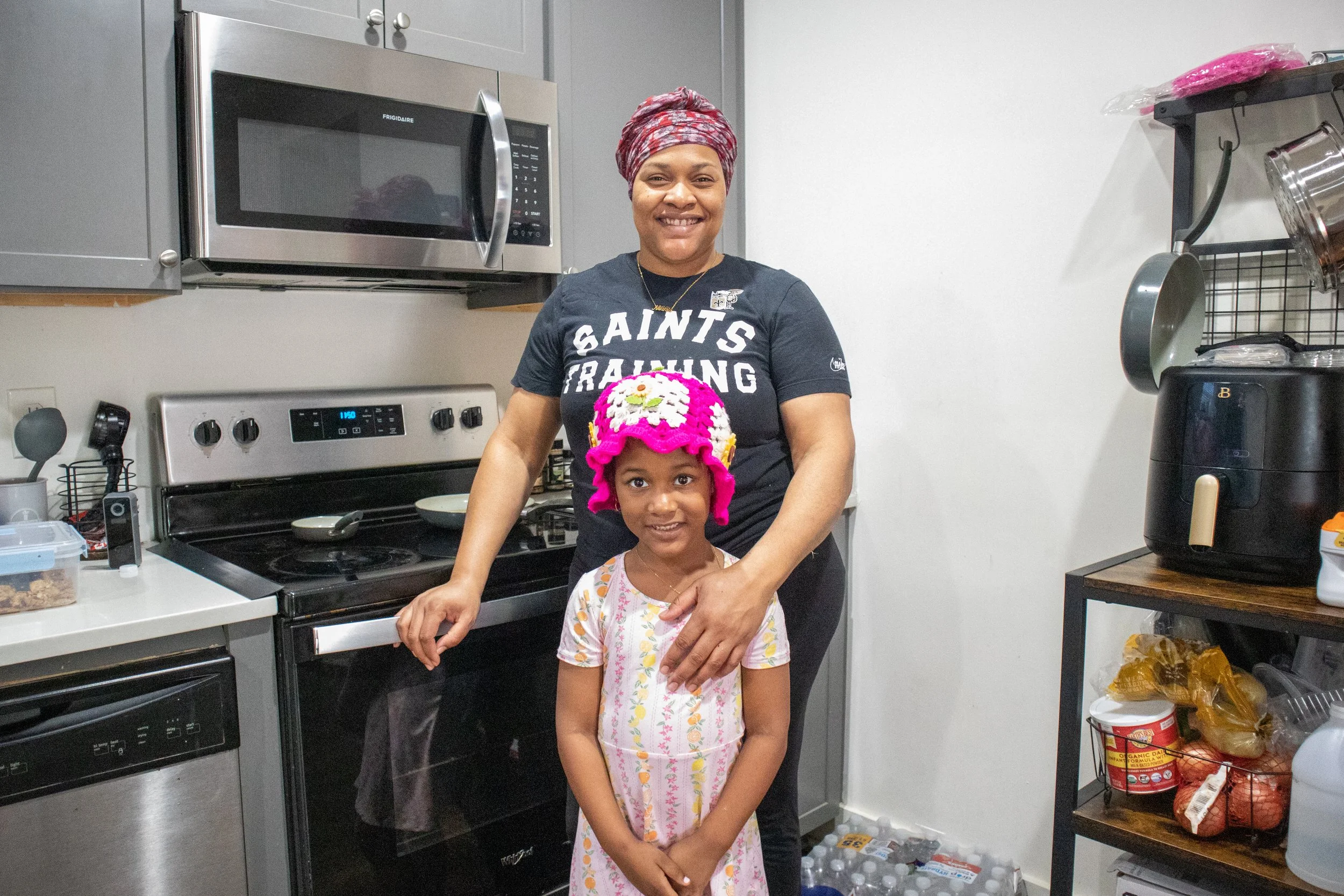
Nikkie Hayes stands, alongside her daughter, in the kitchen of their Mid-City apartment on January 19, 2026.
Between listings for neighborhood events on the community bulletin board at Pagoda Cafe, Nikkie Hayes spotted a flyer for an apartment for rent nearby. The timing was perfect. In 2022, rising rent had forced her and her two children to move in with her grandmother.
She took down the listing and finished working her shift.
“I was like, ‘I'm going to check this out, because I need somewhere to stay,’” Hayes said.
She called the number and filled out the paperwork. Then, Veronica Reed, Executive Director of Jane Place Neighborhood Sustainability Initiative, a community land trust (CLT) and housing rights organization, invited her for a meeting.
That’s when Hayes learned something she hadn’t been expecting.
As Reed explained to Hayes, by separating ownership of the land from the homes built on it, CLTs can keep housing permanently affordable, providing residents like Hayes both financial and emotional stability.
As New Orleans grapples with a housing crisis driven by factors including inflation and rising mortgage and rental rates, shaped by historic inequities, including redlining and disinvestment in predominantly Black neighborhoods, housing advocates say the CLT model offers communities an alternative model to create stable housing outside the volatility of the housing market.
“When Miss Veronica did break down the structure to me, the first thing she said was, ‘If you ever have any issues with your rent, please let me know,’” Hayes recalled. “No one has ever said that to me before. I felt important.”
Hayes, who now has three children, has been living in a three-bedroom apartment managed by Jane Place since 2023. She has come to understand that her apartment is part of a larger movement to build community-based affordable housing, dating back to the late 60s. The model became prevalent in New Orleans following Hurricane Katrina, as neighborhood planning processes took shape and residents came together to navigate the realities of rebuilding after the storm.
“I didn't realize how important it would become to me when I first moved here,” Hayes said. “I was like, ‘Ok, I’ve got somewhere to stay now.’ But then, I started being invited to all of the events and gatherings with other people in the organization. I was just like, ‘Wow, this is really a thing, and they are really fighting for people to have affordable housing.’ They're really trying to make sure I have somewhere to live.”
Years earlier, in community meetings following Katrina, organizers and residents were asking their own questions about the future of their neighborhoods.
At planning meetings held by the Mid-City Neighborhood Organization, Shana M. griffin, an artist, researcher, and co-founder of Jane Place, sat alongside neighbors discussing what rebuilding should look like for their area.
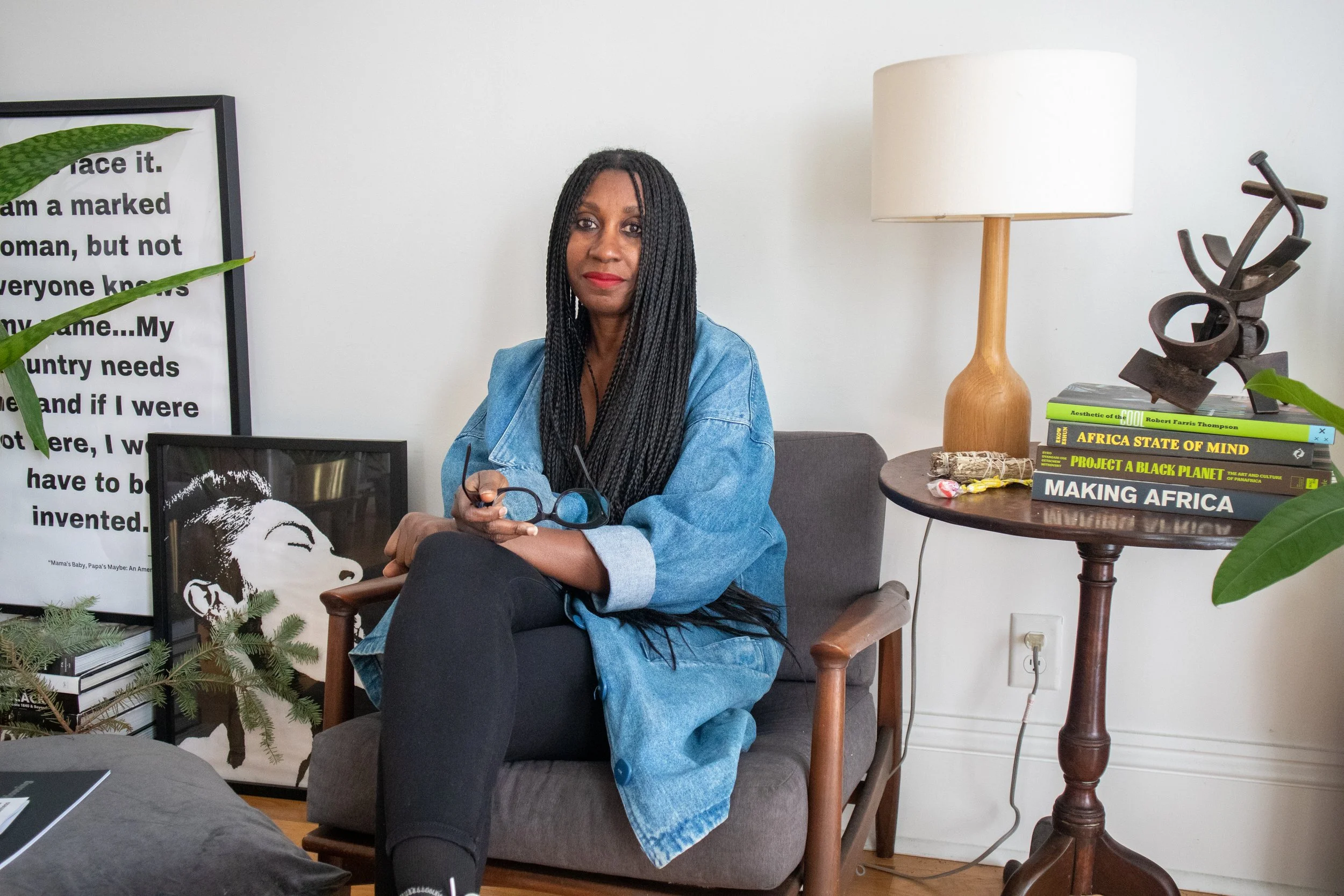
Shana M. griffin sits in her home on January 23, 2026.
“I found myself participating in planning processes for my neighborhood where I was literally going to be planning myself out of my neighborhood,” griffin recalled.
That’s when griffin realized that the improvements residents were advocating for revealed larger tensions between homeowners, renters, and those who didn't identify as either.
At the time, griffin was living in the Lower Garden District after being displaced by Hurricane Katrina. Before the storm, she had spent years in Mid-City and grew up in the Iberville Housing Development in Tremé.
As she attended neighborhood planning meetings, griffin also brought earlier research on community land trusts and limited equity housing co-ops. Those experiences shaped how she understood what she was seeing in real time–and how alternative housing models might intervene in it.
“For me, it became clear that a community land trust was necessary as creating a third option. … Moving beyond this dichotomy of owner versus renter, a land trust model created opportunities for everyone, regardless of your housing tenure status,” griffin said. “Affordability for many people meant Section 8 or public housing, and it was hard for people to think deeply and differently about what affordability could mean.”
The problem of housing affordability was not isolated to New Orleans. Following Katrina, the housing crisis between 2007 and 2012 exposed the volatility of the private housing market on a national level and its inability to protect everyday residents from financial pressure.
“Land trusts are designed for permanence,” griffin said. “As people move in and out, their lifestyles, kids, generations, everything could keep changing, but it's all about taking into account that these things are naturally going to occur. This model is about permanence, because stability matters.”
That permanence is especially significant in New Orleans, where housing insecurity and displacement have shaped the city’s history for centuries.
“New Orleans has been displacing Black communities for over 300 years,” griffin said. “From slavery, through slum clearance, through Katrina, through today, when we think about evictions. The tools change, but the logic is consistent. Black people's presence is treated as temporary.”
Many of the same areas facing high eviction rates and persistent blight today are neighborhoods that were historically redlined, places where banks and federal housing programs once denied mortgages and investment to Black residents.
That legacy continues to shape housing instability in the city. In 2017, New Orleans’ eviction rate was 5.22%–nearly double the national average–meaning roughly one in every 19 renter households faced an eviction order. Between 2015 and 2018 alone, more than 13,000 evictions were ordered in the city, displacing an estimated 24,000 residents.
Data also shows that evictions are not evenly distributed. Neighborhoods that were graded “hazardous” by federal redlining maps in the 1930s now experience eviction rates up to seven times higher than those in historically white, well-resourced areas.
Housing advocates say these patterns reflect a long-standing lack of investment in Black communities–and underscore the need for models like community land trusts that aim to create stability outside of a system that has historically excluded them.
At organizations like Jane Place Neighborhood Sustainability Initiative, that work is already underway.
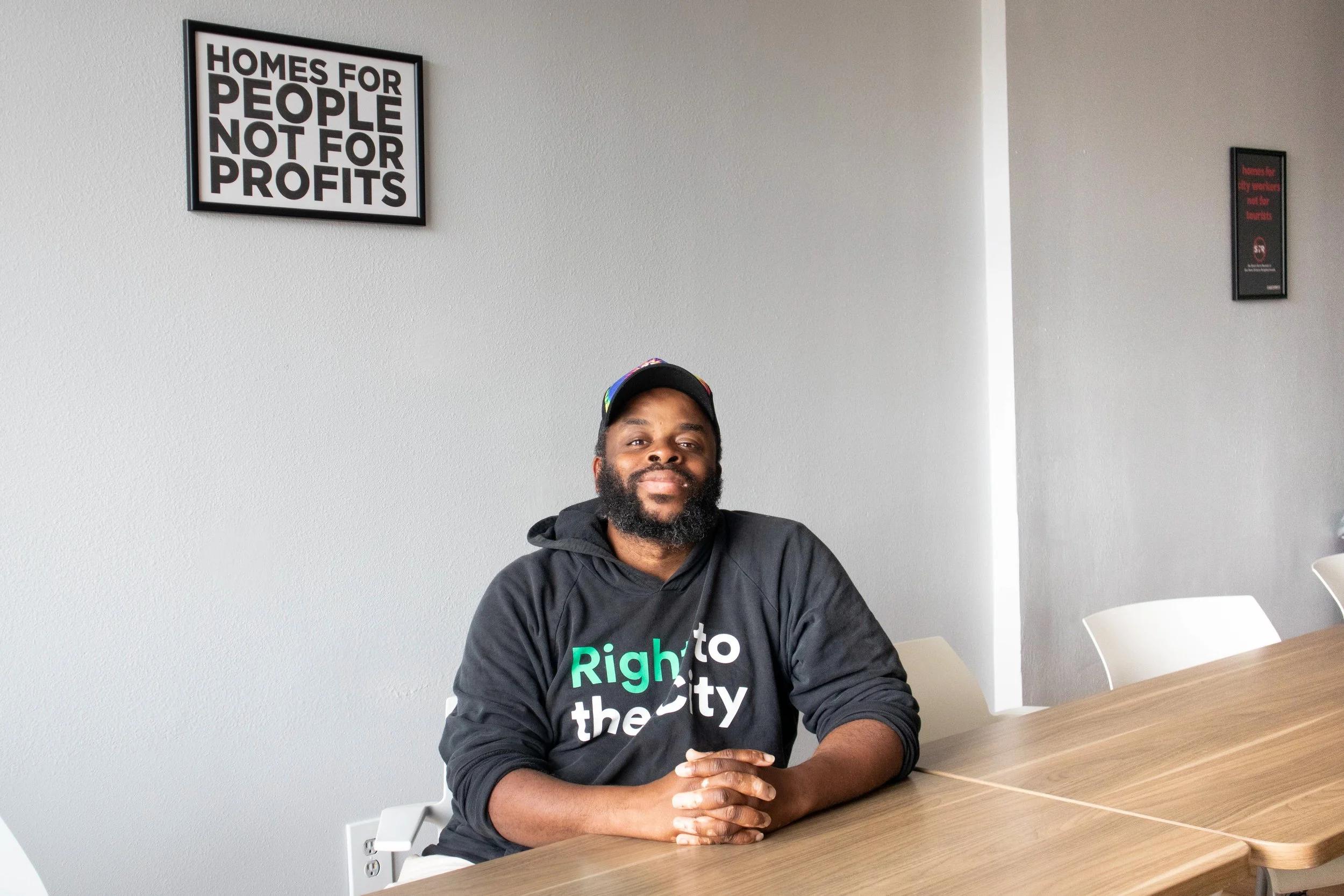
Y. Frank Southall in the Jane Place Sustainability Initiative's Mid-City office on January 19, 2026.
“If we remove profit from housing, we can create homes for people,” said Y. Frank Southall, Organizing and Community Engagement Manager at Jane Place. “That's why it's our tagline, because we take it very seriously in terms of how we think of things.”
Southall became a permanent resident of New Orleans in 2010 and later moved into the building at 2739 Palmyra Street, where Jane Place's organization first took root in 2012. There, he met founders griffin and Brice White, who shaped his thinking around housing advocacy work at the time.
Jane Place’s land trust, he said, is not meant to be a one-off experiment. Organizers see it as proof that communities can build long-term housing solutions themselves.
“Our community land trust isn't meant to be like a demonstration project,” Southall said. “We're able to live out the values of our permanently affordable housing in our land trusts and say, ‘Hey, we can do it; others can do it too.’”
That idea is beginning to gain traction beyond grassroots organizing circles in New Orleans. Housing advocates have increasingly pushed for public investment to support permanently affordable housing models through advocacy policy work.
One recent achievement is the city’s Housing Trust Fund, established in 2025, which is designed to set aside 2% of the city’s annual budget for affordable housing initiatives each year, beginning in 2026.
Oji Alexander, CEO of Peoples Housing+, an affordable housing developer and the one other community land trust in New Orleans, says expanding resources like the Housing Trust Fund is essential if the city hopes to address the scale of its housing crisis.
“There should be money in there to make sure that we're not only building affordable housing, but building affordable housing that's going to remain affordable in perpetuity, which is another upside of the community land trust,” Alexander said.
Alexander was part of Mayor Helena Moreno’s Housing and Affordability Committee, which convened local housing leaders and advocates to identify strategies for addressing barriers to furthering housing advocacy. He says community land trusts are becoming a bigger part of those conversations.
“Community land trusts are an effective tool in a city like ours, mainly because people are spending so much on rent. To be able to provide an ownership stake in a neighborhood that you want to live in, in a brand new house that is energy efficient, that is storm resistant — these are all things that we have to think about,” Alexander said.
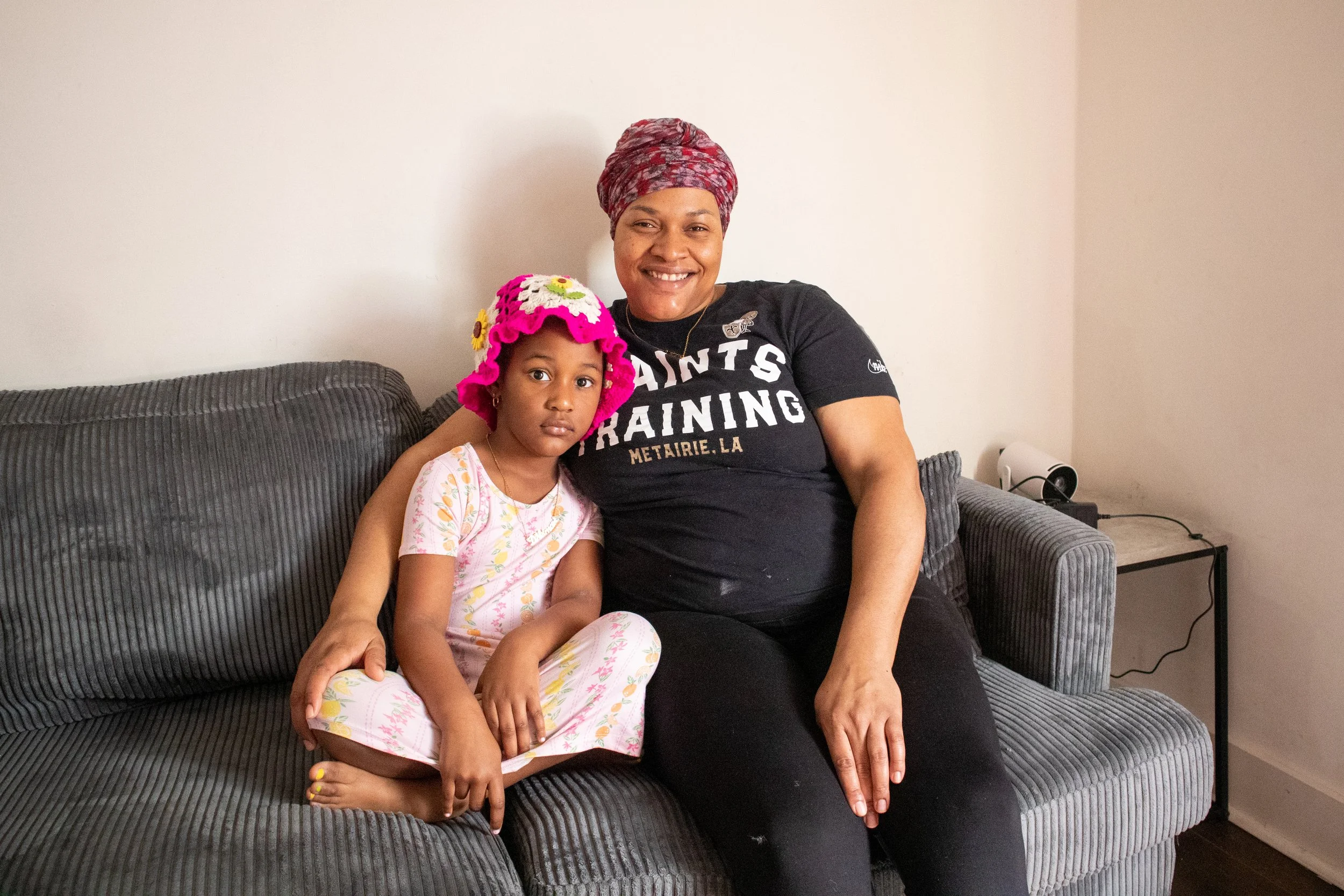
Nikkie Hayes and her daughter sit in their living room in their New Orleans apartment, which is a part of a Community Land Trust stewarded by Jane Place Neighborhood Sustainability Initiative.
For residents like Nikkie Hayes, that stability is not an abstract policy solution but something deeply personal. To her, the land trust represents security.
After years of navigating unstable housing situations, Hayes says living in a land trust apartment has allowed her to pay her bills more flexibly. She doesn’t have to worry that someone’s going to tell her she only has five days to move out or that she’s going to eviction court.
As she spoke about what the apartment has meant for her family, Hayes paused as her eyes welled with tears.
“I don’t have anxiety over my housing,” she said. “I’m really at peace knowing that I’m safe.”
She hopes more residents will have the same opportunity.
“I wish people would understand that community land trust is not just for now. It is for the future too,” Hayes said. “This is here, and it's here for you.”
LAURYN HINTON // Hinton is a designer and creative director from Baton Rouge, and based in New Orleans. She is the co-founder of TBD Magazine, a print publication documenting the underground creative scene throughout the South and Caribbean. Through publishing, programming and community documentation, her work supports artists in shaping narratives grounded in expression, autonomy and collective care. She also served as a 2025-26 Community Reporting Fellow at Lede New Orleans.