
‘Culture is the New Cotton’: The failed promises of the Musicians’ Village
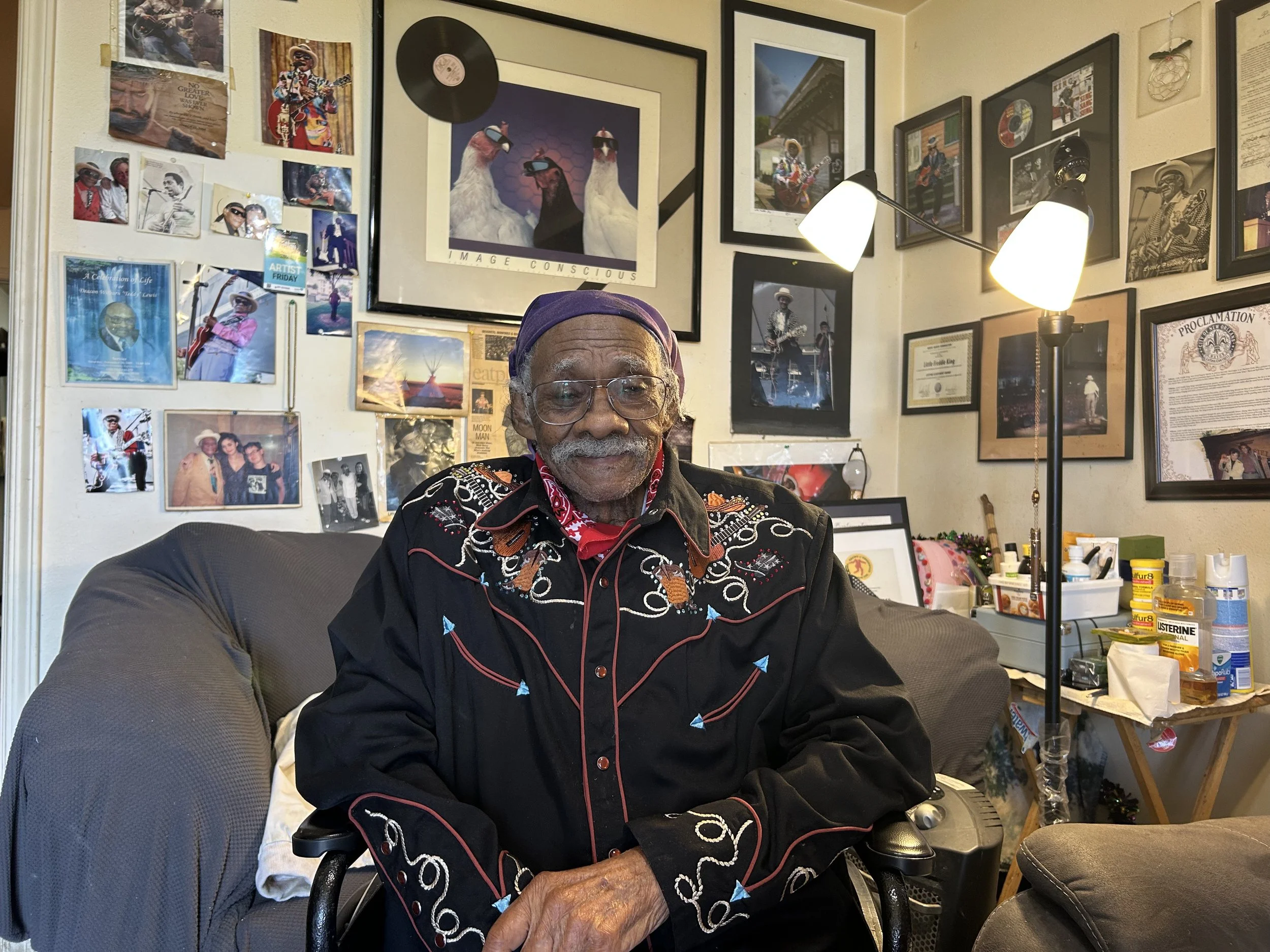
Little Freddie King in his apartment at the Musicians’ Village. Photo by Drew Hawkins
Strumming a guitar on his porch after work every evening in McComb, Mississippi in the 1950s, Fread Martin’s father taught him two things that would shape the course of his life.
The first was three guitar chords: E-major, A-major, B-major and then back to E-major. That progression laid the foundation for his music, eventually transforming him into legendary bluesman Little Freddie King.
The second was how to hop on a moving freight train. In 1957, at 14 years old, he did just that, stowing away on a boxcar bound for New Orleans. “I didn’t have no suitcase,” King said. “I just had a pillowcase and throwed a couple pairs of pants and a shirt in there.”
His first arrival to New Orleans was bumpy. He bailed at Claiborne Avenue and hit the ground “like a spinning top,” tumbling and rolling until his skin and clothes were torn up. As he lay there battered and bruised, he looked up at the sky and said, “thank you Jesus.”
His second arrival to the city, 50 years later, came with a parade and champagne. He’d been living in Dallas after evacuating for Hurricane Katrina. His longtime manager, drummer, and friend “Wacko” Wade Wright had applied and gotten him into the Musicians’ Village, a cluster of modest duplexes built by New Orleans Area Habitat for Humanity to bring back the city’s musicians and culture bearers scattered by the storm. “I said, ‘Why y'all got a festival in the street, and why y'all keep telling me congratulations?’” King recalled. “They said, ‘This is why.’”
He was handed the keys to his home, along with a Bible. “I said, ‘Lord have mercy,’” King said. “What a deal.” For nearly 20 years, King paid $375 a month, covering his walls with guitars, photographs, and records—a museum to a life spent traveling the globe, playing the blues.
Habitat kept the rents for eight rental units like King’s in the Village at $200 to $400 a month—unchanged, subsidized at a loss, because these were the people who made New Orleans what it is.
Last September, Habitat sold those eight units, along with 44 others, to a Metairie landlord for roughly $33,000 a unit—far cheaper than they’d go for on the open market. The new owner, Sam Madi, didn’t waste time. By December, tenants like King were getting letters saying their rents would nearly triple.
King is 85, no longer performing, living on $1,800 a month in Social Security, and using a wheelchair after falling off his electric bicycle around the same time his home was sold. He said Habitat never notified him about the sale. He found out when he got a letter from the new landlord saying his rent would be increasing to $1,100 a month, due to “increases in property tax, materials and insurance” and to “align with fair market value.” It felt like a betrayal, King said—like the “rug had been pulled out from under me.”
“I had no opportunity to ask nobody or nothing,” King said. “They never said, ‘Mr. King, we’re going to sell the place, were you interested in buying it?’ Now that would have been a really nice, right thing to do. But they didn’t do any of it.”
Selling these properties far below market value, without first giving the people they were built for a chance to buy them, reflects a broader pattern. Instead of providing long-term, sustainable support, post-crisis relief fades. And ultimately, wealthy landowners benefit at the expense of the people who create the city’s culture and drive its economy.
In a statement, Habitat said it sold the properties to Madi because the organization’s mission “is to build resilient homes that are affordable and can be owned by New Orleans area families in need of safe and reliable shelter” and “managing and servicing a rental portfolio is not our core mission.”
Speaking on background, a representative explained Habitat’s standard process for becoming a homeowner: After applying and being selected, applicants show they can afford the mortgage, take classes, and complete around 300 volunteer “sweat equity” hours, helping with Habitat projects instead of paying a cash down payment. They added that “someone who can only pay $200 in rent per month is not likely in a position to afford a mortgage.”
Habitat did not explain how the homeownership process works for landlords with large housing portfolios, but it appears to be different for Sam Madi, who simply paid $1.7 million for 52 units without having to take any financial literacy or home maintenance classes or log any sweat-equity hours. Madi declined to comment for this story, citing “previous journalistic misrepresentations regarding this subject.”
The sale and subsequent rent hikes sparked a backlash. Meetings were held, people were angry about the idea of tenants like Little Freddie King being evicted. It became another crisis. In response, the Housing Authority of New Orleans (HANO) said they were working out a deal with Madi.
For the next year, HANO will pay Madi $2,286 a month to help cover the rent for four households in the Musicians’ Village, including King’s. “We are using unrestricted reserves to keep the households at Musician's Village housed for twelve months because the group is extremely vulnerable,” said HANO director Marjorianna Willman in an email. “They found themselves in this situation due to no fault of their own, and stabilizing households aligns closely with the work that HANO does every day.”
For King, that arrangement works out to HANO providing $500 a month. Along with $600 a month in support from Music Maker, a North Carolina foundation, his rent is covered for at least a year. But the money does not go to Little Freddie King. It goes directly to the landlord.
Willman said HANO can’t interfere with lease negotiations or private transactions, but she wishes they had been made aware of the situation prior to the sale of Musicians’ Village because “there may have been an approach that provided permanent housing solutions for the residents.”
King is happy to have at least a year’s worth of stability, but he doesn’t know what he’ll do when the funding from HANO goes away. “See me after 12 months,” King said.
His friend and manager, Wright, said there needs to be more long-term support for musicians and culture bearers, not just short-term fixes. “They're the biggest ambassadors of this city you got,” Wright said. “Yet, the musicians are starving artists.”
It’s a sentiment echoed by artists around the city, who say they were shocked but not surprised to hear about the sale of the Musicians’ Village properties and rapid rent hikes.
Reggie Ford, an artist selling prints and paintings in Jackson Square, said he’s watched the same dynamic play out before. He pointed to the American Can Co. apartments, where elderly and disabled residents on fixed incomes were displaced after rents were raised and units converted to market-rate housing—another instance, he said, of public money becoming private profit.
“At the end of this whole thing, this whole structure goes back to some private owner at below-market rates. It's the craziest thing,” Ford said. “It's just almost like poor people or underprivileged people being used as pawns to make private investors wealthy.”
Musician and advocate Arsène DeLay said she’s watched the same pattern consume her own Seventh Ward block. Her family has been in the neighborhood for over a century. But rents are going up, neighbors getting priced out, houses becoming short-term rentals.
DeLay has worked at nonprofits in the city, including the New Orleans Musicians’ Clinic, where she was manager of “Makin’ Groceries,” a program launched at the beginning of the pandemic to deliver food and health education materials to the homes of elder and at-risk culture workers.
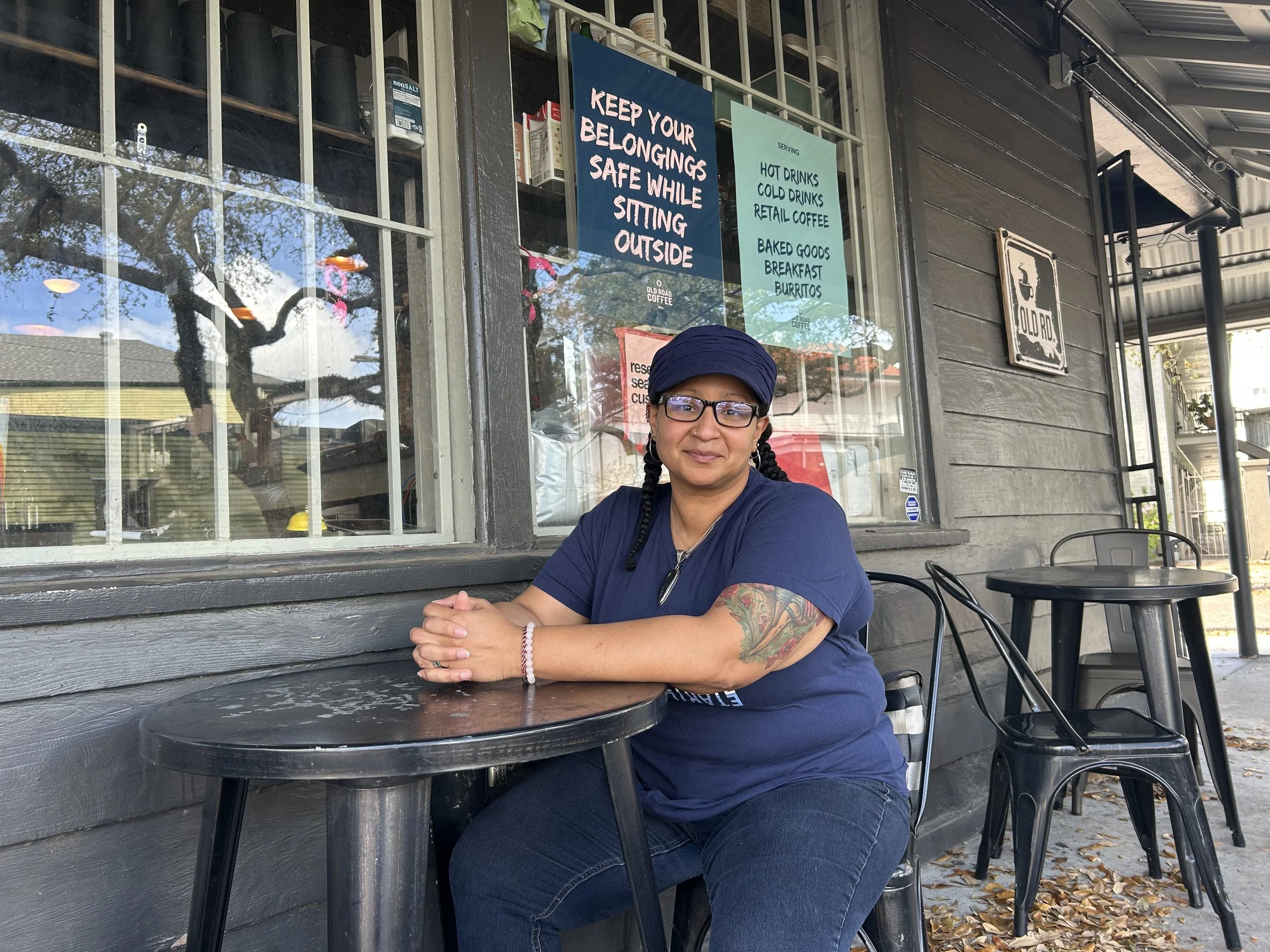
Musician and advocate Arsène DeLay sits at Old Road Coffee. Photo by Drew Hawkins
She described what is happening to Musicians' Village as another example of support following a crisis that doesn’t insulate vulnerable communities like musicians and culture bearers from the same thing happening again with the next crisis.
"The culture is the new cotton," DeLay said. “The intention of Musicians' Village was to create legacy housing for musicians after everyone lost everything… You've sold these houses downriver.”
A sudden increase in rent is an especially difficult storm for musicians in the city to weather. The Music and Culture Coalition of New Orleans (MaCCNO) conducted the most comprehensive survey of musician income ever attempted in the city, speaking with over 800 people during the pandemic. The survey found the median annual income for a New Orleans musician in 2021 was $24,000. The bottom 75% of earners averaged under $21,000. Gig pay has barely moved since the 1980s—the median take-home from a single gig was $100 to $125.
MaCCNO researcher Hannah Kreiger-Benson did the math on how many $100 gigs it would take for a musician to satisfy the federal Housing and Urban Development (HUD) standard that rent and utilities should be 30% or less of your total income. For an apartment that’s $1,300 a month—around the average rent in 2021—a musician would have to play 42 gigs per month. "Who the fuck has time to play 42 gigs a month?" she said. "Not to mention burning yourself out."
In the five years since, housing costs have gone up even further, along with basic necessities, including food and utilities. The average rent in New Orleans is $1,700, according to Zillow. Before paying utilities, that’s now 56 gigs paying $100—14 more than it would take five years ago.
Some advocates say the vulnerability of musicians and culture bearers illustrated by the sale of Musicians’ Village was not just surprising, but predictable. Gene Meneray, co-founder of The Ella Project, which advocates for progressive cultural policy, said those concerns go back to the Village's founding. "People who had been in the field for a while were looking at this and saying, you know, these people don't necessarily own these projects," Meneray said. "And that is something that could come up to be a concern in the future."
The tools to do better exist and are not expensive, Meneray said. He listed initiatives like a property tax credit for live music venues that present regular shows and charge a cover, state arts funding that hasn't increased in a decade despite Louisiana ranking 45th in the country per capita in arts spending, and reforming permitting processes so cumbersome they discourage the very cultural activity the city markets to the world.
Raising the City's Arts Council budget from $600,000 to $1 million wouldn't register on the deficit, Meneray said. Shifting enough state grant money to double the funding rate for New Orleans artists from 25% to 50% would cost approximately $100,000, he estimated. These are not large numbers for a city whose economy runs on the work of the people being squeezed out of it.
What it would take, advocates say, is treating the culture like the infrastructure it actually is—not a marketing asset to be leveraged for big events, supported in the aftermath of a crisis, and then abandoned in the years between.
"It should be based on a need at the time and not a disaster," said Reggie Ford. "Something's always gonna happen. For the city that the culture is the backbone of its economy, we gotta do something that's really gonna help every year, every day, and not based on these catastrophic events.”
King, for his part, is not bitter. He is grateful—for his friend Wright, for the support of Music Maker, for HANO, for everyone who came through in his time of need. But he has no desire to leave the place he’s called home for nearly 20 years.
"Right here, I'm satisfied and comfortable as I can be," he said. “As long as the Good Lord keep me, this the little pocket that I wanna be in. Right here.”
— — —
This story was published in partnership with Antigravity Magazine. You can view this story in print here.
DREW HAWKINS // Hawkins is the public health reporter for the Gulf States Newsroom, a collaboration among public radio stations in Louisiana (WWNO and WRKF), Alabama (WBHM) and Mississippi (MPB-Mississippi Public Broadcasting) and NPR. He covers stories related to health care access and outcomes across the region, with a focus on the social factors that drive disparities. He also served as Senior Reporter & Mentor at Lede New Orleans, advising the 2025-26 fellowship cohort.